
Urban Circularity: Eco-Design and Upcycling to Create Added Value
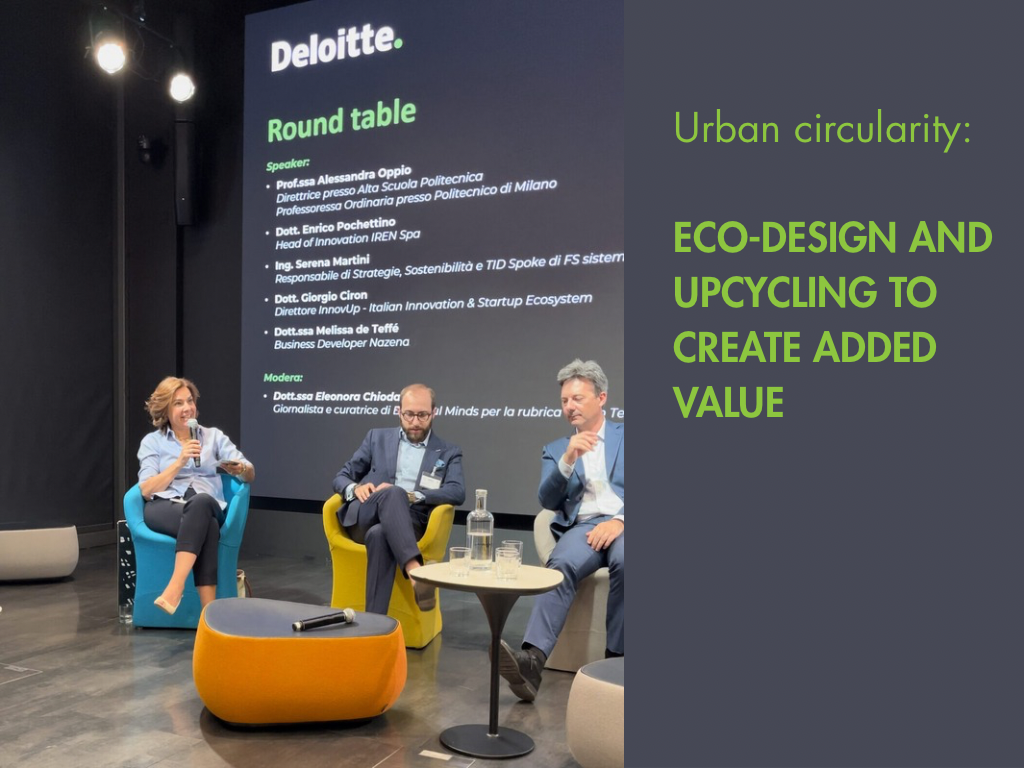
On Monday, June 19, 2023, we participated in Deloitte’s roundtable discussion titled “CircularCity Innovation Lab – Accelerating the Circular Transition” which focused on urban circularity.
Nazena has been selected and included among the startups of interest to CircularCity, an open innovation program that aims to identify the most promising solutions from startups and scale-ups designed to transform cities in line with the macro-trends of circularity, while addressing the market’s business and innovation needs.

The panel, moderated by journalist Eleonora Chioda, also featured Melissa de Teffé, our International Business Developer, who discussed our goals and how we are working to achieve them by addressing industry challenges and seizing opportunities in the circular economy.

The focus: Why are cities so important when it comes to the circular transition?
The first reason is linked to the massive process of urbanization; in fact, more than half of the world’s population now lives in cities (according to the UN, this figure will rise to more than two-thirds by 2050) and secondly, because we must consider that people in cities consume 78% of the world’s primary energy and account for more than 70% of carbon emissions.
Cities therefore represent both a challenge and an opportunity for keeping global warming within the limits set by the Paris Agreement.
The Global Situation
Despite growing awareness of these issues, only 7.2% of the global economy can be considered circular (Circularity Gap Report). The report highlights that the amount of resources and materials used is constantly increasing; in fact, it is projected to double by 2050.
And in Italy?
The 5th Circular Economy Report by the Circular Economy Network shows that Italy is the most circular country among the top five EU economies (Spain, France, Germany, Italy, and Poland). In particular, the report highlights that Italy has one of the highest recycling rates in the EU (72% compared to an average of 53%).
The circular economy represents an opportunity, both for regions and cities, to rethink production and consumption models, services, and infrastructure, and above all to serve as fertile ground for innovation.
For example, Milan is part of C40, a global network of nearly 100 international cities united in action to combat the climate crisis and committed to using an inclusive, collaborative, science-based approach to reduce their fair share of emissions by 50% by 2030.
The Role of Innovation in the Circular Transition
In addition to being at the forefront of the fight against climate change, cities are also where financial, commercial and public plans converge.
Circular development, like sustainable development, is in fact a type of transition that must be systemic to succeed and relies on strong interconnections between sectors. This means that innovative ways of (re)thinking production and consumption systems must be implemented.
Key Areas for Developing a Circular City
There are four interconnected macro-trends of strategic importance for improving urban infrastructure toward a virtuous model of circularity.
Therefore, the areas of greatest interest for the circular economy in cities are: materials, transportation, resources and water.
1. MATERIAL CYCLE
Optimization of the material cycle and land use, through:
• Recycling of construction materials
• Nature-based solutions
• Energy optimization
2. TRANSPORT & MOBILITY CYCLE
Creation of a shared and clean mobility system, through:
• Mobility as a Service
• Active mobility
• Smart logistics
3. RESOURCE CYCLE
More efficient use of resources in the urban context, through:
• Eco-design of products
• Viewing the city as an urban mine
• Smart logistics
4. WATER CYCLE
Closing the water cycle, through:
• Recovery from contaminated sources
• Rainwater harvesting
• Reduction of water losses
Resource Cycle
When it comes to the Resource Cycle, within the framework of the circular city, it is essential to meet the goals set by the EU. This requires innovative solutions that enable the use of both primary and secondary resources, further reducing waste generation.
The resource cycle focuses on the more efficient use of natural resources available in the urban context, where reuse, repair, and recycling are facilitated, and goods and products are shared and recovered at the end of their life cycle. This cycle focuses on reducing the extraction of new resources, optimizing the use of existing resources, and creating more sustainable consumption patterns. This involves adopting circular design strategies, promoting the circular economy, and implementing waste management infrastructure and systems that encourage the reduction, reuse, and recycling of resources.
These are strategies and measures that we at Nazena have always shared and promoted.
What does Nazena do?
At Nazena, by recycling textile fibers, we transform industrial textile waste and used clothing into new products.
This is a circular economy solution designed to transform and innovate the fashion industry in line with the principles of environmental sustainability — and beyond.
In this way, we reduce textile production waste by giving it new life and reintroducing it into the production cycle.
We also work constantly to support companies on their journey toward sustainable innovation. Ours is a patented process of upcycling and sustainable innovation that allows us to recover up to 100% of textile fibers and create a durable material that can be shaped to meet the customer’s needs. We are, in fact, able to create various product concepts, ranging from packaging to furniture, as well as home decor items and acoustic panels.

How much do we recycle in Italy?
Deloitte has highlighted that Italy ranks well compared to other countries, but has not yet met the EU targets.
There has been a 23% decrease in the amount of municipal waste sent to landfills in Italy (2011–2021).
The EU target for municipal waste sent to landfills is 10%.
Let’s not forget that there are areas for innovation to work on to improve these figures:
• Smart waste logistics
• Use of secondary raw materials
• Repair services
• Product life extension
• Cities as urban mines
• New recycling technologies
The Role of Innovation
Innovation is essential for the full realization of a new circular model. Significant investments and the growing focus on circularity can be channeled toward the development of innovative, circular, and sustainable technologies, partnerships, and business models.
Sustainable and circular innovation is driven by three key assets:
1. PRODUCT INNOVATION
• New Technologies
• New Materials
• New Processes
2. ECOSYSTEM INNOVATION
• New Relationships
• New Partners (manufacturers, suppliers, regulatory authorities, etc.)
3. BUSINESS MODEL INNOVATION
• New Value for Stakeholders
• Greater Resource Efficiency
The CircularCity Lab aims to identify the most innovative and promising startups in the circular economy, particularly within CircularCity’s four strategic segments: Materials, Transport & Mobility, Resources and Water.
It is an honor to have been selected as one of the relevant startups for CircularCity, Deloitte’s open innovation program that aims to identify the most promising solutions from startups and scale-ups to revolutionize cities based on the macro-trends of circularity, in line with the market’s business and innovation needs.

The Principles of the Circular Economy in the Resource Cycle
Integrating the principles of the circular economy into the resource cycle can lead to reduced consumption of virgin materials, lower levels of waste and toxic substances, better utilization of products and an overall reduction in environmental impact.
We have access to various types of products in our daily lives: food, consumer goods, electronics, and clothing — all goods that enable us to enjoy a good quality of life. However, the current linear model of production and consumption involves the extraction of finite resources, their processing, and the generation of large volumes of waste.
Given the steady growth of the urban population, this is no longer sustainable.
The World Economic Forum estimates a 116% increase in material consumption when comparing 2010 figures (41.1 billion tons) with projections for 2050 (81.8 billion tons). The shift from a linear to a circular approach is therefore essential to meet the growing demand for resources.
In the transition from a linear supply chain model to a circular one, the market faces, first and foremost, a challenge of innovation.
What strategies should be adopted?
Adopting circular strategies makes it possible both to develop effective and scalable methods for waste collection, transport and management and to recover value from waste through upcycling, reuse, recycling and — only as a last resort — disposal, in order to generate added value.
ECO-DESIGN
The eco-design approach requires conceiving products and services from a circular perspective, designed for reuse, repair and recycling.
ALTERNATIVE SOURCING
To reduce the exploitation of primary resources, a key solution is to transform end-of-life materials into secondary raw materials and reintroduce them into the flow, finding new applications within the urban context.
URBAN MINES
Cities should be viewed as “urban mines” that provide large quantities of resources in the form of waste during a period of raw material and energy crises.
SMART TRANSPORT
Smart transport for waste management can help reduce the environmental impact associated with transporting collected waste in urban areas.

The primary objective of the CircularCity Innovation Lab is to develop a new open innovation ecosystem to bring together the knowledge, expertise, technologies and resources of various stakeholders in line with the macro-trends of the CircularCity.
Innovation can support, enhance and drive circularity.
Creativity and innovation are about finding unexpected solutions to obvious problems, or finding obvious solutions to unexpected problems.
Rei Inamoto
Tags: circular transition, circularity, deloitte, ecological transition, recycling, resource cycle, sustainable cities, urban circularity


